

Introduction: Where I Stand
In case you have been living under a rock: Substack now lets you check any article you want for AI, using the leading AI-detection software Pangram, for free. At first, it seemed like this was great. But now it’s out and my feed is full of people who have absolutely lost their minds with rage. Let’s talk about it.
First, I’ll make my stance clear.
The status quo on the internet before Substack announced this policy was completely unacceptable. It’s very likely that, if nothing was done, the world wide web would become functionally useless in a matter of years, perhaps less than a decade. Some might say that’s hyperbolic, but I feel it’s conservative. (Ha! Contrast! LLM-style!) Just in case you haven’t seen a particular now-famous graph, I’m sharing it below.
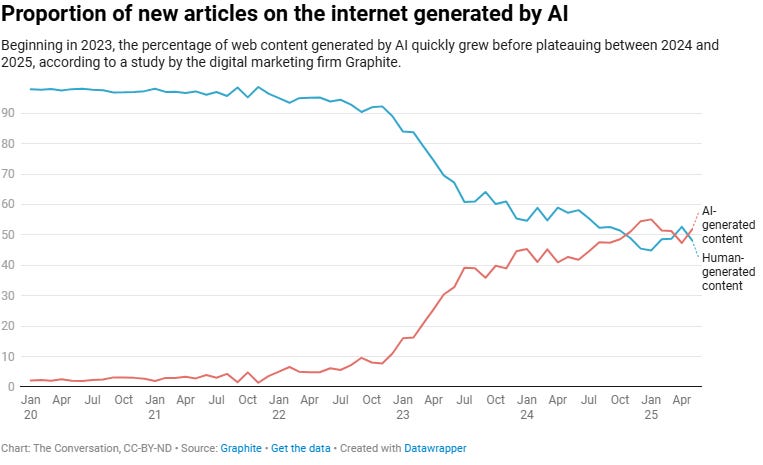
One interesting thing about this graph is that it presents us with a strict binary that a lot of “AI writers” are protesting against: Is an article ‘generated’ by AI, or is it not? What about ‘AI-assisted’ people, who only use it to aid their process? Do they really deserve to be lumped in with people who “fire and forget” wholly generated articles into the internet?
Yep. They sure do. Also I’m not sure to what extent they actually exist. By which I mean: someone, somewhere, is probably the soulful “AI-assisted” artist these people try to portray themselves as, but I doubt it’s a statistically significant population.
This is another aspect of my stance that I must acknowledge. I have spoken out, at length, against authors who consider themselves ‘AI-assisted.’ If you don’t want to read those lengthy comments, I’ll give a motive-first interpretation of their behavior: I think that the modern internet rewards the ability to produce massive amounts of content extremely quickly, creating a huge impetus to churn out daily posts regardless of whether they are good, and that this is AI’s core use-case for an online blogger. Therefore, I believe the arguments that most “AI writers” use are self-serving rationalizations that allow them to feel morally justified in the exploitative act of polluting the internet with semi-human (at best) slop, for profit. This is backed up by their absurd posting rate, sometimes multiple times a day, and the length of their articles in spite of that rate. If it was about quality, there wouldn’t be such a focus on quantity.
These writers might agree with what their machine output generates, and even feel a sense of ownership over it, but everything that makes that post ‘good’ or even ‘useful’ to a wider audience is generated by the machine. Even taking the most AI-agnostic approach: their articles are useless to you because you could almost definitely prompt Claude a few times and get the same thing, yourself.
And because so many of these writers have already become adept at justification, deluding either their audience or themselves, you can’t expect that they’ll have a measured and good-faith response to Substack’s integration with Pangram.
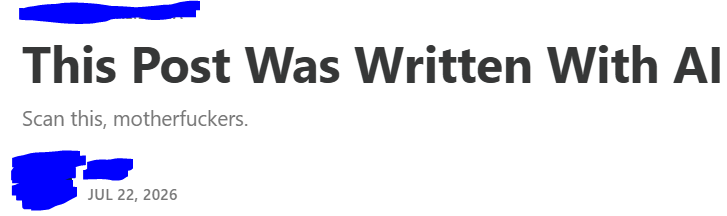
That being said, I am not AI-agnostic. I am firmly anti-AI. But I also think that any anti-AI stance can only be weakened through impracticality, ignorance of facts, or belief in a world that is functionally no longer possible. So to be as direct as possible:
I am in favor of Substack’s integration with Pangram. And through that lens, I am going to acknowledge the problems and complications that this development presents us with, and argue back against the people who want to do away with it.
One last thing: look at that like to comment ratio in the main substack announcement! As of writing, it is 6.3k likes to 1.3k comments, and of course not every comment is critical. Underlying all of this, we have to keep in mind the silent majority who want to be able to know when a post is AI-written, and that what I’m addressing here are the arguments of a loud minority.
So let’s (finally) start addressing them.
Argument 1: It doesn’t matter whether I use AI
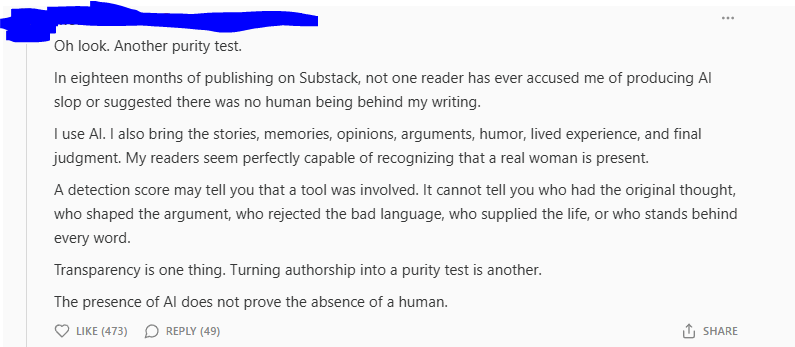
I’m starting with the absolute worst argument, inherently self-defeating. I’ll work my way up to the stronger stuff.
But why is this so bad? This AI-generated comment seems to have a firm grasp of how to form a logical argument! (Whether from human or robot, I do not know.) If people like it, won’t they just keep liking it?
Sure. They’re free to. Remember what this tool does: It offers nothing but transparency. It doesn’t cast AI posts into the abyss. All it does is reveal whether AI was used, and hopefully to what extent.
And this is where the argument becomes entirely self-defeating. If your readers really do not care, then why are you mad? Is it, perhaps, because you never disclosed that you were writing with AI? That you took a ‘don’t-ask, don’t-tell’ policy and convinced yourself that you were not actually conning anyone? I wouldn’t accuse you, (that’s a lie, I absolutely would) but you seem to be incriminating yourself, here.
If you’re afraid of your AI-written text popping up as “AI-written,” and angry that everyone can now have access to that knowledge on Substack’s dime instead of paying for Pangram themselves, I’d really love for you to explain why, without telling me that you were tricking people.
But I’m not going to stop there: Because these fears that your AI-posts will be rejected by readers are valid. I, personally, do care whether you used it. But why? Why would I look at the same post, human-written vs not human-written, and get the ick with the latter?
To me, it’s simple. One post is a fully human message. The other is not. It’s compromised by tropes it stole and automatic generation and things that were not actually intellectually considered by a human brain. Even if it sounds the same to you, it is inherently worth less. It doesn’t matter whether the machine is lying where a human could also be lying. It definitely doesn’t matter if the machine is wrong where a human could also be wrong. Am I getting every single one of these words from a person, or am I not?
And if you want to call that irrational, religious, spiritual, sure. I like to think of it as the elevation of people over machines, and the valuing of the human mind and soul, in all its intricacies, with not a single word corrupted by auto-generation. Despite all their flaws, I love humans and value the things created entirely by them. Fuck clankers. Moving on.
Argument 2: Pangram Has An Error Rate!
There are two responses to this, I’ll start with the easy, less complicated one.
If Pangram is detecting your human-written prose as AI-written, you have the ability to report it as an error before you ever click “post.” You are also allowed to clarify to your audience how it was written. We can also assume that you’ve built up a library of Substack posts before this point, and will continue building it. Pangram’s error rate is real, but low, and it is virtually impossible for, say, a dozen of your human-written Substack posts to all be flagged as AI. If a false positive did occur, (and I’ll be looking for an actual post that this happens to, not a what-if.) it seems pretty easy to fall back on your archive of clearly human-written posts and say: “Pangram is flagging this, I don’t know why.”
But I think that a lot of people making this argument aren’t particularly interested in those solutions. In fact, I think that many of them want Pangram to have a higher error rate than it does, because it materially benefits them to cast doubt on its results.
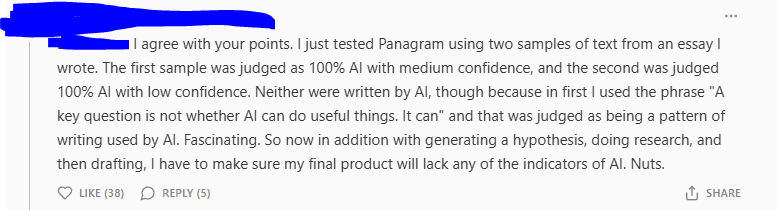
If the above comment is true, that’s a big strike against “Panagram,” as it is called here. (And so many people on Substack now suddenly seem to have written mysterious invisible essays that got false-flagged for AI! Wow!) However, just below, this user leaves a second comment.
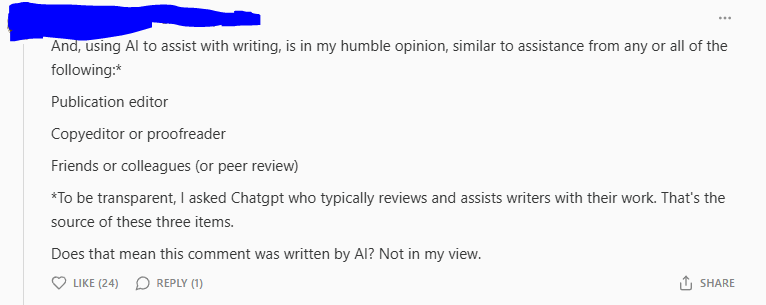
I include these two posts because they’re a more honest version of discourse floating around the pro-AI internet that’s always frustrated me. “Don’t assume AI without proof” deceptively used as a mask for: “Using AI is fine.”
The performative sympathy many showed to Mia Ballard of Shy Girl infamy focused on “innocent until proven guilty.” But it ignored a simple reality: While it’s difficult to prove that someone else did write something with AI, it’s pretty easy for you, personally, to prove that you did not. You should have access to your document history. Or, if you’re one of the rare people to handwrite or use a typewriter, you should have access to your actual physical, PC-less writing. Ballard did not show any of this. She immediately blamed her editor and disappeared from the public sphere without presenting proof. And while I won’t point any direct fingers, most Substackers who preached of her presumed innocence have been giving me some, ahem, ‘interesting’ Pangram results for a while. (Yes. I have already been using it.)
But I will be entirely fair. While this is what I often see when I look at comments from people terrified of ‘false’ positives, I’ve heard the stories of overzealous college professors ignoring the evidence that something was human-written. I’ve also heard how these systems are unfair to neurodiverse (and especially linguistically diverse) people. I think the solution to those problems is for AI-checkers like Pangram to get better, and for us to get better at responding to them.
We can do our part by recognizing that these checkers are imperfect, but still useful. At which point it becomes easy for any human writer to make the case that they did not use AI, especially when they have all the evidence of their writing process. If certain groups get falsely flagged at higher rates, let’s talk about why that happens and how to fix it. I’m down for that conversation. But in order to properly have it, we should reconsider the self-motivated ‘empathy’ from AI-writers who seek to categorically dismiss all detection. If ‘inequity’ is a datapoint that they can use in that argument, do you think that they actually want it to improve?
Argument 3: Pangram is also AI, and AI is bad
Hoo boy, shit’s about to get complicated.
The statement: “Pangram uses AI” is true. It is, in fact, why Pangram is so good at what it does. Unlike other AI checkers which look for patterns alone, or inhuman weirdness, Pangram seems to have an almost intimate (firsthand?) understanding of how AI chooses to word things.
If you look at my Anti-AI posts in the past, you can see that my stance has been consistent. I don’t like GenAI. But one thing has been difficult: A path forward. ‘Turn off every datacenter on the planet’ sounds sexy, but it isn’t happening any time soon. Giving up and embracing an AI future is for losers. Whatever it is, it has to be between those two extremes.
We no longer have the choice to entirely opt out of a post-AI world. OpenAI, Anthropic, and others took that from us when they stole our data. The AI writers who do not disclose that they are using it take that from us every day when they confuse us and deliberately obfuscate their process, then make themselves out to be victims when they are rightfully called out. If your stance is: “I don’t want to use AI, I don’t want to know if anyone else is using it, I want to live in a world without AI entirely” then you are ceding everything that matters in this fight, just the same as if you’d given up and embraced it, because other people are using AI, and you will read their work.
So long as LLMs have a powerful influence in our world, programs like Pangram will be the best tool for fighting back. Unlike ChatGPT’s wide-ranging uses for scrambled-up plagiarism, catching that plagiarism is Pangram’s only function. Without tools like these, we will be lost in the woods entirely. Using undetected AI, our leaders will be able to lie to us and our thoughts and feelings will become increasingly susceptible to corporate control and manipulation.
You need to get very good at recognizing what is fake very fast, and you need every good tool that can possibly be in your arsenal.
But Pangram will train itself using my data.
I invite you to look at their data policy. According to them, they do not do that.
I don’t trust them. They’re lying and they’re using everything Substack is giving them to train their AI.
Here’s an image of something that you probably clicked. If you didn’t, I strongly encourage you to go to dashboard→settings and click it now.

There, did that feel good? AI scraping problem solved, right?
You just clicked a button next to a small paragraph of tiny text, written by a company that is absolutely trying to make money off of you, which is the same company that just integrated Pangram into its interface. This text declares that it is refusing to give your publicly-accessible writing to multiple companies that have proven that they are willing to steal data to train their AI systems.
You may choose to trust this, and not Pangram. I don’t understand that choice, but it’s yours to make.
Pangram’s incentive is to be reliable. It makes money when people can trust it. That’s not foolproof. Someday, in the way that shifty tech companies do, they might dodge around providing a good product in exchange for profit. But I’m not as worried about that right now as I am about a world in which AI writing has taken over the internet without anyone being able to recognize it for what it is.
Conclusion, and my Criticism
Okay actually I’m doing this in the reverse order.
I do have one significant criticism regarding Substack’s Pangram roll-out, and I think it’s the thing that gave the “Pangram is evil” faction some ammunition. At first, an opt-out button existed, but only after you’d done your Pangram check on any given post. If this particular button was mentioned in the “Against Claudefishing” article, I missed it.
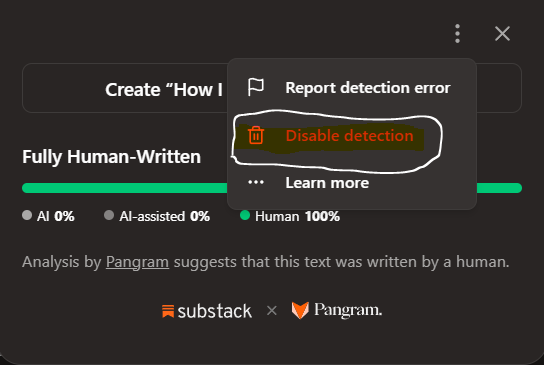
In less than 48 hours, Substack revisited the feature and changed it to this.
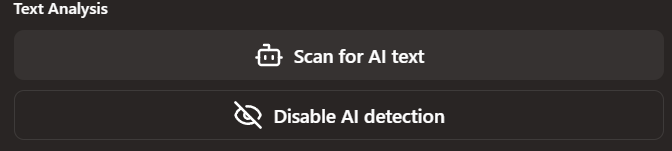
Meaning there is now a giant and immediately visible opt-out button from this entire thing. Significantly more accessible than before. This is, most charitably, a waste of time as a feature. People are going to find out what “AI detection has been disabled for this post” means very quickly. A goofy compromise providing a layer of obfuscation that serves no one.
One last thing: If you’re one of the people in category #3, you’re right not to trust the tech industry, right now. You’re right to doubt any particular tool, any particular message that you see on the internet. What we have to do is weigh the reality we experience with human discernment. Pangram is now on Substack, but the truth is: I was using Pangram on Substack posts before it was integrated, and I was often horrified at the things I discovered to be 100% AI. It’s shocking how good LLMs already are at getting past our intuition.
But once I started using Pangram a lot, I started to be able to do it on my own. Soon, the patterns in the text that kept getting flagged became familiar. I even started being able to tell the difference between when a human uses contrast, and when an AI does, in a way that is hard to articulate. (←AI probably would not write that style of contrasting sentence, at least not in its current models.)
So please, empower yourself. And be grateful for the tools you’re given to do so. We’re in for a pretty rough future, and we need to know what’s fake even when our human perception fails us.
This is the article I wanted to write and am glad someone took it up!
It’s really helpful because the different arguments against Pangram all run cover for each other.
I'm so glad to see someone looking at it from this perspective (and not afraid to share it!). I’m actually writing an essay that shows how AI has severed the millennia-old link between good writing and good thinking, and with catastrophic repercussions. I did some due diligence to see if anyone had made a similar argument.
I found three articles. And all three were 100% AI-generated.
Please, someone tell me a better definition of irony.
Again, great piece.